How much money does this blog make?

This blogs has exactly 96 posts (this one included) at the time of writing. I complement the traditional Google AdSense with Infolinks. The later complements AdSense by using more of the “blog real estate”; which would otherwise be left unused.

I also run various affiliates programs for which I get paid when a customer redirected by this blog ends up making a purchase. I have come to the realization that affiliate programs in general are a better way to monetize your content. You just need to find a product/service niche that you could target. In this category, I use Amazon Affiliates US, Amazon Affiliates Canada and Ding.

Up to the end of last month (January 2017-September 2017) I made the following:
I hope this article gives you a realistic idea of how much you can make by blogging. I would appreciate if you share with us the monetization systems that you use and any tips about blogging monetization. Please, drop a line in the comments section just below.

If you liked the post, then give us thumbs up by clicking the Google Plus (G+) button at the beginning of this article.

Renting vs Owning a Condo in Toronto – the math exposed

Most people in Toronto (and Canada for that matter) think renting Real Estate is synonym with throwing away your money. I disagree: I think nowadays in the GTA renting is superior to owning from the financial point of view.

I have always liked math, because math is proof. For my own sanity I did some calculations to objectively measure the financial appeal of renting vs owning a Condo.

A Condo? What about the other forms of Real Estate property? Well, I am focusing on a Condo, because that’s where I am planning to live for the next few years. You can do similar calculations if you wish for other types of properties (detach, semi, townhouse, etc.)

I went to Condo.ca and found a unit of my liking (see image below with all the details). This particular unit I can rent for $1,950 a month. The only other money I will need to pay as a renter for this unit is hydro (electricity), since air conditioning, heat, water and parking are already covered by the rental price. If I pay $150 monthly for hydro; then the grand total for renting this unit will be $2,100.00.

Now let’s see how much it will cost me to own this place:

The unit size is 875 square feet (SQ.FT) and the average price per SQ.FT at The Station Condos at this moment is $603; which means the price of this unit is around $527,625.00 ($603 x 875 SQ.FT). 

If I put down 20%, then the mortgage amount would be $422,100.00. RBC, my bank, is currently offering a 5 Year Fixed rate at about 2.8% per year. The monthly interest is equal to the outstanding mortgage times the mortgage rate, divided by 12 months in a year: $422,100.00 x 0.028 = $11,818.80 / 12 = $984.90 per month. (This does not include the payment of the principal, it just includes the interest payments of the mortgage) 
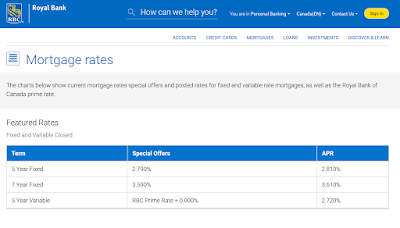
Mortgage Rates - RBC - April 1st, 2017
Now let’s calculate the implicit rent. Say what!?!? "The amount of income you haven’t earned because you have owned your home instead of investing in other things is implicit rent." This is a very interesting concept and it is not trivial to grasp. It is very well explained in The Wealthy Renter – Chapter 4

To calculate the implicit rent we have to look at the equity we have in our property. Assuming that we just bought with a 20% down payment; then the equity is $105,525.00. We estimate the implicit rent by multiplying the equity by the yield of an alternative investment and dividing by the twelve months of the year. Let’s say my alternative investment is the S&P/TSX Dividend Aristocrats Index. The Yield on this index is about 4%. The implicit rent is $105,525.00 x 0.04 = $4,221.00 / 12 = $351.75.

Currently the monthly maintenance fee (a.k.a. Condo fee) at The Station Condos is $0.52 per SQ.FT. That means the monthly maintenance bill for this unit should be around $455.00 ($0.52 x 875 SQ.FT)
“For homes owned through a condominium corporation, most of the costs of maintenance (but not all) are covered by the condo fee. Still the condo corporation might underestimate the costs of maintenance and end up raising condo fees to make up for deferred maintenance. Or, if they wait too long, they might take a special assessment (a large one-time fee charged to all unit owners) to cover a major repair.” - The Wealthy Renter by Alex Avery.
In the City of Toronto the Property Tax for multi-residential housing is in the range from 0.5% - 1.5% of the assessed value of the property. Let’s assume the property tax for this condo unit is 1% (the middle point in that range) and let’s also assume that the asking price matches the assessed price $527,625.00. That means the annual property tax on the condo unit is about $5,276.25 or about $439.69 on a monthly basis.

The owner of this unit will also have to pay for hydro; all the other utilities are included. Let’s say the cost of hydro is $150 per month (the same amount as if we were renting)

For simplicity I won’t consider other fees like home insurance, title insurance or CMHC insurance (if you buy with less than 20% down payment). 

Now let’s put all together:
  • Mortgage Interest Payments: $984.90
  • Implicit rent: $351.75
  • Condo fee: $455.00
  • Property Tax: $439.69
  • Utilities (just hydro): $150.00
  • Grand total: $2,381.34
Finally, let’s compare: renting $2,100.00; owning: $2,381.34. Renting beats owning. You might think the difference is not much, but notice that this number does not include the payments towards the mortgage principal (you still have to pay for that as part of your monthly mortgage payments).

Also, consider what happens if the interest rates move a little higher. Today we live in a world of very low interest rates, which is not normal. As the US FED hikes the rates, the Bank of Canada will eventually hike the interest rates as well. And what that means is that you can expect higher mortgage rates down the road. 

Also, as a renter you have the flexibility to move in order to chase career opportunities in a moment’s notice or simply move because the neighbor next door is a pain in the derriere. 

Also, the renter is not buried in debt. Many (most?) homeowners are buried under a mountain of debt. The funny thing is that many homeowners don’t see the mortgage as debt. Well, I have news: mortgage is debt and it comes with risks; risks a renter does not have.

If you want to dig a little deeper into this topic, consider buying the The Wealthy Renter: How to Choose Housing That Will Make You Rich by Alex Avery. It is a great book on the topic, written as recently as 2016 by someone who (unlike me) is not an amateur. The Kindle version costs less than $5 bucks.

If this article was helpful, please show it by clicking the Google Plus (G++) button at the beginning of this post. Also, feel free to drop a line in the comments section below with your opinion, questions, corrections and suggestions.

The Station Condos Facts - Building Values and Trends - March 28th, 2017

The Station Condos Facts - Amenities - March 28th, 2017

How to calculate the Ontario’s Surtax?

In simple words, the Ontario’s Surtax is a second layer of taxes (on top of the Basic Provincial Income Tax) that residents of the province of Ontario, Canada are obligated to pay to the tax man.

The calculation of the Ontario’s Surtax is a two-step process:

First, you calculate the Basic Provincial Tax on your personal income. Second, you take the Basic Provincial Tax calculated in the first step and do some math (we’ll explain that shortly) to calculate the Ontario’s Surtax. What’s important here to understand is that the surtax is calculated not on your income, but on your Basic Provincial Tax.

In case you are interested, this my personal discount link for TurboTax 2017. You get a 20% discount and I get an Amazon Gift Card. Win-Win :-)

The provincial tax rates and income thresholds for the Province of Ontario for 2016 are follows:

Annual taxable income ($)             Provincial tax rate (%)
0.00 to 41,536.00 5.05%
41,536.01 to 83,075.00 9.15%
83,075.01 to 150,000.00 11.16%
150,000.01 to 220,000.00 12.16%
220,000.01 and over 13.16%

Also, everybody in Ontario is entitled for a basic personal tax credit return. This number can be found in row number 1 of the TD1ON form for the corresponding tax year. This number is $10,011 for tax year 2016.

Knowing the tax brackets above, your personal income and the basic personal tax credit amount, then you can calculate your Basic Provincial Tax in Ontario. We call it “Basic”, because it does not include the surtax amount yet. Your Total Provincial Tax would be the sum of the Basic Provincial Tax plus the Ontario Surtax. 

For example:

A person making $60,000 owes $3,282.00 in the form of Basic Provincial Tax in Ontario. To calculate this number we apply the tax brackets above as follows:

= 0% * $10,011 + 5.05% *  ($41,536 - $10,011)  + 9.15% * ($60,000- $41,536.01)

= 0% * $10,011 + 5.05% *  $31,525  + 9.15% * $18,463.99

= $0 + $1,592.0125 + $1,689.455085

= $3281.467585

= $3282 (rounding up to the nearest integer)

So, $3282 is the Basic Provincial Tax of a person making $60,000 annually.

Doing some similar math we can calculate the Basic Provincial Tax for other incomes. I am not going to do all the calculations again, but they will be awfully similar to the one we just did. I’ll just spit the numbers now but you can double check them later:

Personal Annual Income ($)      Basic Provincial tax (not including the surtax yet)
$60,000 $3,282
$80,000 $5,112
$95,000 $6,724

Now let’s calculate the Ontario Surtax: 

If your Basic Provincial Tax is less than $4,484, then your surtax is $0. That means that a person with a $60,000 income won’t pay any surtax just because its Basic Provincial tax is $3,282 and that number is less than $4,484.

If your Basic Provincial Tax is greater than $4,484 and less than or equal to $5,739, the surtax is 20% of the basic provincial tax payable over $4,484. Let’s break it down: a person making $80,000 owes $5,112 in basic provincial taxes. The surtax will be calculated as 20% * ($5,112 - $4,484) = $125. The key thing here is that the 20% is only applied to the number between $4,484 and $5,112. The initial $4,484 won’t produce any surtax.

If your basic provincial tax payable is greater than $5,739, the surtax is 20% of the basic provincial tax payable over $4,484, plus 36% of the basic provincial tax payable over $5,739. For a final example, let’s consider the person making $95,000 annually. This person would owe $6,724 as Basic Provincial Tax. The surtax will be calculated as follows: 20%* ($6,724 - $4,484) + 36% * (6,724 - 5,739) =$802.

Now that you know how to calculate the Ontario Surtax, we can go ahead and calculate the Total Provincial Tax. Let’s use the following formula:
Total Provincial Tax  =  Basic Provincial Tax + Ontario Surtax
For instance:
  • A person with a $60,000 annual income will owe a Total Provincial Tax of $3,282 = $3,282 + $0
  • A person with an $80,000 annual income will owe a Total Provincial Tax of $5,237= 5,112 + $125
  • A person with a $95,000 annual income will owe a Total Provincial Tax of $7526= $6,724+ $802.
If you liked the article, please give me thumbs up by clicking the Google Plus (G+) button at the beginning of this post. Also, if you have any questions, corrections or suggestions, then feel free to drop me a line in the comments section just below.

Dash cams for cold weathers and snowy winters


When it comes to cold climates, the most vulnerable element of the dash cam is the battery. Batteries don't get along with extreme temperatures, neither extremely low nor extremely high. A solution to this problem is to use a capacitor (instead of a battery), which is immune to the cold or heat.

Another aspect to consider is that during the winters, the days become shorter and shorter while the nights are correspondingly longer.  Furthermore, visibility conditions are often poor during the winter even during the day. A dash cam with night vision support is the way to go to work-around these issues.

I live in Toronto, Canada and I ended up buying  a DDPai mini2 dashcam. It is equipped with a built-in supercapacitor and it features night vision as well. In addition, I bought a separate 128 GB MicroSD card with Class 10 rating that is not included with the camera and it is required to store the footage.

I am happy so far with the camera and I definitely recommend it. 

If you have a dash cam and live in a cold place as well, do you mind telling us about it? What kind of camera did you get? Is it working properly? Any other tips that we should consider when buying a dash cam for a cold climate? I would definitely appreciate if you leave us a comment below and give this article thumbs-up by clicking the Google Plus (G+) button at the beginning of this post.

Holiday Inn Hotel & Suites Windsor (Ambassador Bridge) Review

Our party of 7 stayed at the Holiday Inn Hotel & Suites Windsor (Ambassador Bridge) for one night (Saturday, May 7th, 2016). We just needed a place to spend the night after visiting Point Pelee National Park early that day. Check out our adventure in Point Pelee by clicking the link above.

We were 3 couples: 6 adults and one kid; so, we occupied 3 rooms.

We all agreed that the place was fairly decent. It was clean, quiet and the service was great.

We checked-in late in the afternoon and went directly to the swimming pool after dropping our belongings in the rooms.  (Ah, we got a WIFI pass-code when doing the checking: the connection speed was good enough)
Room at Holiday Inn Hotel & Suites Windsor (Ambassador Bridge)

Our room at Holiday Inn Hotel & Suites before we mess it up
The pool was clean and nobody else was there. It belonged to us for the next hour and a half. Clean towels are provided in the pool.
Swimming pool at Holiday Inn Hotel & Suites Windsor (Ambassador Bridge)
There is a hot-tub in the pool area; which we enjoyed of course.

From there we went to the rooms to have a shower. The rooms looked kinda old, but they were clean and well organized. 

I have two complains only:
  • The hair dryer in my room was out-of-order. The hair dryers in the rooms of my other trip comrades were ok (I asked them). I could have called reception to get it replaced, but my wife insisted to keep her hair a little moist.
  • The air conditioning was working properly, but at some point during the night it started to make very annoying noises. I think the pipes got frozen somehow and because of that the device started to malfunction. I had to turn it off and use it in fan-mode for the rest of the night.
We had dinner and some drinks at Grill 55. This restaurant/bar is next to the lobby of the hotel. The food here was great. Pretty much everyone in hour group ordered something different and everybody liked it. I must say we were very hungry, but still, the quality of the food and the service was excellent.

Parking is conveniently located directly in front of the main entrance of the hotel. You can see a Tim Hortons directly from the parking lot; where we had breakfast in the morning.

As I said, we just stayed one night: we checked in late in the afternoon and left early the next morning. We had no chance to check the other amenities of the motel.

Overall our stay was positive and I would not mind to stay at this place once more.

We picked this hotel because we wanted to do some sightseeing around Windsor and the location was fairly close to the Windsor waterfront. We liked Windsor, and we will share our experiences in another post.

If this information was useful; share it with the Google Plus (G+) button at the beginning of this post. Thanks.